
Cartagena
A UNESCO walled city that has survived pirates, conquest, independence, and Gabriel Garcia Marquez. Still intact. Still electric.


Some countries have beaches. Some have mountains. Some have history. Colombia has all of it, at the same time.
Plan your Colombia journeyColombia occupies just 0.77% of the Earth's surface. It contains 10% of all plant species on the planet. It has more bird species than all of North America and Europe combined, 1,900 and counting. It is home to the jaguar, the tapir, the spectacled bear, the pink river dolphin, and the harpy eagle. All at the same time. All within reach.
The reason is simple: Colombia sits at the convergence of two oceans, three Andean ranges, the Amazon basin, the Orinoco plains, and the Caribbean coast. No other country in the world has this configuration. The result is not diversity. It is superabundance.
We have been guiding travelers through this landscape for 13 years. The reaction we see most often at the first morning in the field is not excitement. It is silence. The kind that happens when something is actually overwhelming.


Left to right: Nevado del Ruiz volcano, Tatacoa Desert, and San Andrés from the air. Three completely different ecosystems within the same country.
“Colombia is not the most visited country in South America. It is the most rewarding one.”
Lonely Planet, 2024 Best in Travel
The Colombian Pacific is not a beach destination. There are no resort strips, no all-inclusives, no cruise ships. What there is: 1,300 kilometers of pristine jungle coastline, humpback whales that arrive every July from Antarctica to give birth in the warm Pacific waters, and Afro-Colombian communities who have maintained their traditions, their music, and their relationship with this coast for over 400 years.
Choco, the province that covers most of this coast, is consistently rated one of the five most biodiverse places on Earth. It rains here 300 days a year. That rain is the reason the forest looks the way it does, and the reason most tourists never come. Which means you have it almost entirely to yourself.
We have been partnering with local guides and Afro-Colombian communities in Bahia Solano and Nuqui for years. Access is by small aircraft or boat. The experience is unlike anything else in South America.


Whale watching season: July to October. Best access via Medellin to Bahia Solano (35-min flight). No roads in or out. Which is the point.


The Colombian Coffee Region, the Eje Cafetero, is a UNESCO World Heritage landscape. Rolling emerald hills, colonial white-and-red farmhouses, and family operations that have been tending these slopes for four generations. Colombia is one of the only countries in the world where coffee is picked by hand, year-round, because the altitude variation means there is always something in harvest.
But the Coffee Region is not just about the coffee. The culture of the paisas, the people of Antioquia and the coffee belt, is one of the most distinct in Latin America: entrepreneurial, warm, intensely proud, and impossible to summarize in a paragraph. You experience it in the way strangers talk to you, in the quality of the food, in the music that comes from every open door.
We arrange private farm stays with third-generation growers, cupping sessions with Colombia's top specialty roasters, and access to Salento, Jardin, and Filandia, villages that feel untouched because they largely are.

Salento, Quindio, the most photographed street in the Eje Cafetero, and still genuinely worth it.
A UNESCO walled city that has survived pirates, conquest, independence, and Gabriel Garcia Marquez. Still intact. Still electric.

Colombia's largest national park and the site of the world's largest collection of ancient rock art, with evidence of human presence going back tens of thousands of years. Deep in the Amazon region.

The Lost City of the Tayrona people, older than Machu Picchu, accessible only on foot, and still a living sacred site for four indigenous groups.

Over 500 monolithic statues scattered across highland meadows, a UNESCO site and one of archaeology's greatest unresolved mysteries.
“Colombia has 9 UNESCO World Heritage sites. Most travelers visit zero of them because they don't know they exist. We fix that.”
Colombia does not just have music. Colombia is music. Vallenato, born on the Caribbean coast, is a UNESCO Intangible Cultural Heritage. Salsa arrived in Cali and became something that exists nowhere else: a style so distinct it is called Cali-style worldwide. Cumbia spread through all of Latin America from the Colombian coast. And in every neighborhood in every city, music happens spontaneously, on street corners, in restaurants, at parties that start at midnight and end at sunrise.
Traveling with music as a lens changes Colombia completely. We arrange evening sessions in Cali with world-class salsa dancers who are not performing for tourists. They are performing because this is what they do. We take you to the Barranquilla Carnival, the second-largest in the Americas, if your timing allows. We find the cumbia nights in Mompox that most visitors never reach.
Even if music is not your primary interest, you cannot visit Colombia without it finding you. It is not a feature. It is infrastructure.
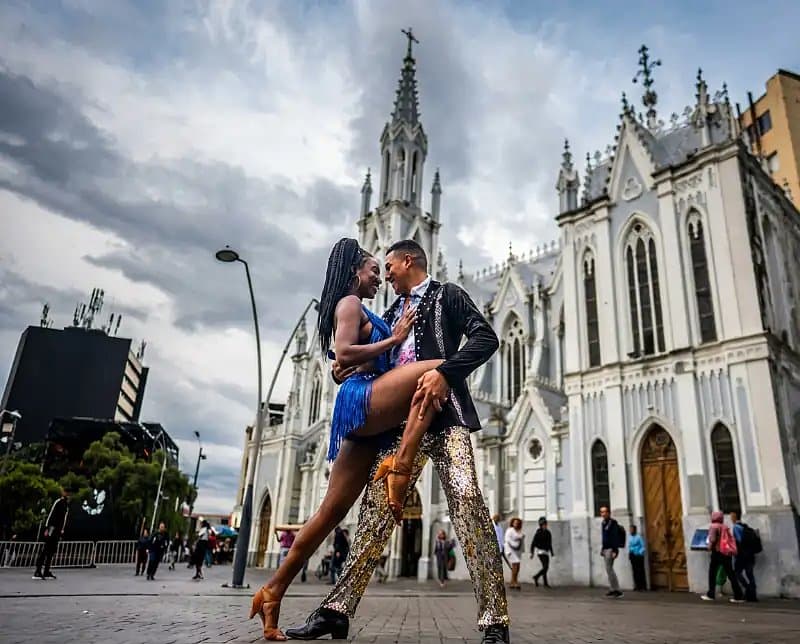
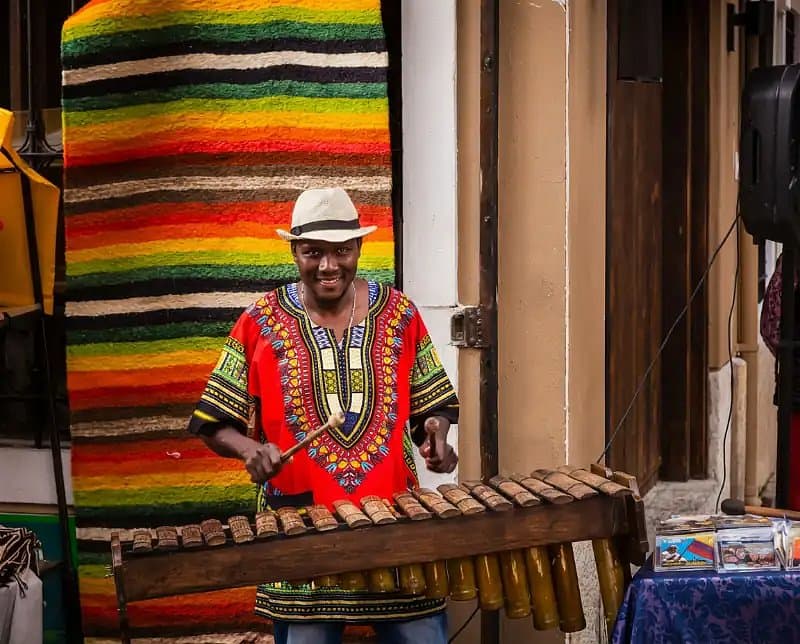
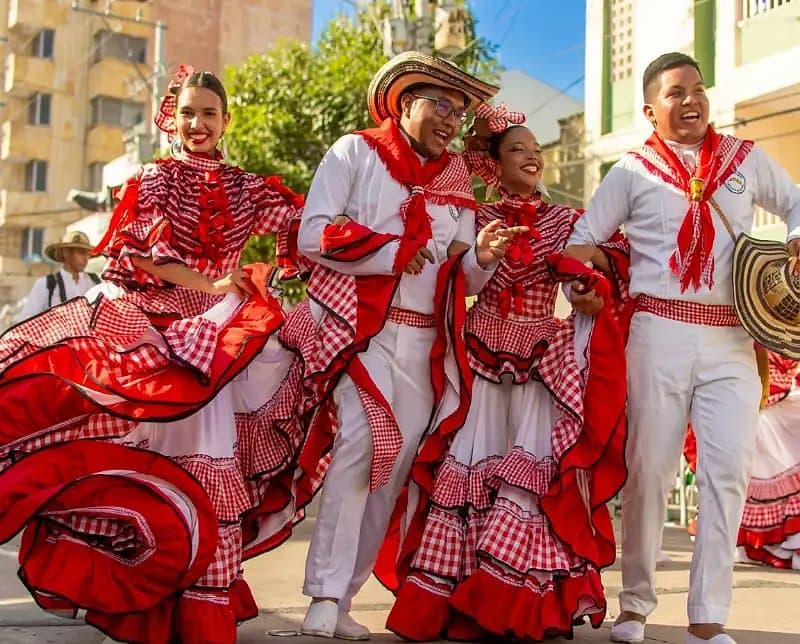
Music is not a side note in Colombia. It is how the culture stores its memory. Ask any guide what song their grandmother sang and they will know immediately.

Colombia does not have one cuisine. It has at least six, shaped by altitude, ocean, forest, and the three distinct populations, indigenous, African, and Spanish, that converged here over five centuries.
On the Caribbean coast: ceviches, coconut rice, and fried fish pulled from the water that morning, served at a plastic table on a beach that probably does not have a name. In the coffee region: the Bandeja Paisa, a plate of beans, rice, chicharron, chorizo, arepa, egg, and avocado that is not a meal but a statement. In Bogota: a restaurant scene that has produced four of Latin America's top 50 restaurants, driven by chefs working entirely with Colombian produce and indigenous technique.
The arepas alone vary by 40+ regional variations. The aguardiente is not something you drink because it is traditional. It is something you drink because it is genuinely good. The jugo de lulo is unlike anything available outside South America.
Food in Colombia is not a highlight. It is a daily event that accumulates into one of the best arguments for the country you will encounter. We plan every itinerary with meals that are not an afterthought.
"Colombia rewards travelers with an extraordinary combination of diversity, warmth, and experiences that feel genuinely off the beaten path, even when they are not."
"For too long, Colombia's natural and cultural wealth was overshadowed by its reputation. That reputation no longer applies. What remains is extraordinary."
Colombia won South America's Leading Destination award at the World Travel Awards for the third consecutive year, recognized by travel professionals across the industry.
Colombia consistently ranks among the top destinations globally. The traveler community noticed years before the mainstream press did.

I grew up here. I have spent 13 years watching Colombia through the eyes of people experiencing it for the first time. The reaction is always the same: disbelief, then something that looks like relief. Like they had expected less and found something that quietly exceeds every version of what travel is supposed to feel like.
Colombia is not a hidden gem. It is one of the most extraordinary countries on Earth, and the world has simply been late to say so out loud. Every traveler we send home tells us the same thing: they are coming back. Not because they missed something. Because they want more of what they found.
This is the country I get to share with you. I have never taken that lightly.
No forms. No commitment. A real conversation with someone who knows this country deeply, and genuinely wants to get your trip right.